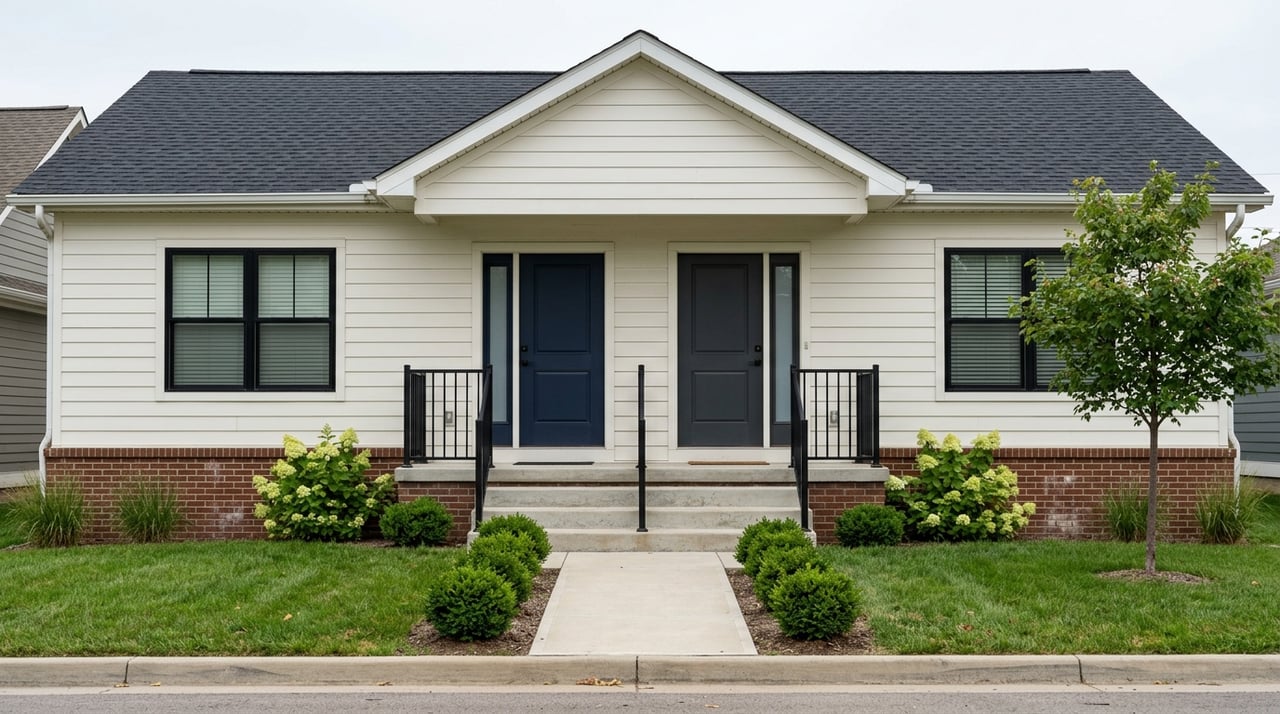
Gibson County Rental Investing: Single-Family or Duplex?
If you are weighing a rental purchase in Gibson County, one question matters fast: should you buy a single-family home or a duplex? That choice affects your budget, tenant pool, day-to-day management, and how stable your rental income may feel over time. In a county with rising rents, strong workforce demand, and a housing stock led by detached homes, the better fit depends on what kind of investment you want to run. Let’s dive in.
Gibson County is a relatively small housing market with 15,215 housing units, and about 75.8% of those homes are owner-occupied. That matters because it helps explain why rental inventory can feel limited and why the right property type can stand out quickly. It also reflects a market where single-family homes already make up a large share of the housing stock.
The numbers also show real rental demand. Median gross rent is $914, and the county housing needs assessment found that average asking rent rose from $817 in 2014 to $957 in 2024. The same report says 63% of survey respondents want more rental options, which is a strong signal that demand has not disappeared in this mostly owner-occupied market.
Local employment is part of that story too. Manufacturing is the county’s largest industry, Toyota Motor Manufacturing Indiana is listed as a 7,000-plus employee employer, and the housing study estimates nearly 9,000 inbound commuters work in the county. When jobs draw people in, housing demand tends to follow.
If your goal is to match the widest renter demand in Gibson County, single-family rentals have a strong case. The county housing study says most housing units are single-family detached, and survey respondents showed very strong support for more single-family housing. Nearly 90% said they would support more single-family homes.
That preference lines up with what many renters say they want. The survey highlighted top preferences like a yard, proximity to work, and limited maintenance. A detached rental often checks those boxes better than a shared-wall property.
This can matter for tenant stability too. A single-family home may appeal to renters who want more space or a layout that feels closer to homeownership, which can support longer stays depending on the property and lease terms. In a market where development has slowed in recent years, a well-kept house can fill an important gap.
Public market data suggests countywide home prices cluster around the mid-$190,000s. Realtor.com reports a median listing price of $194,950 and a median sold price of $194,250, while Redfin also reports a median sale price of $194,250.
Within that range, there is still a wide spread. Current listings include everything from lower-priced fixer properties under $100,000 to homes around $700,000, with many livable 2- to 4-bedroom houses in roughly the $150,000 to $250,000 range. For many investors, that creates a more familiar entry point than waiting on the right duplex to hit the market.
Public single-family rental examples in Gibson County mostly fall around $1,000 to $1,975 per month. Current examples include a 2-bedroom, 1-bath house at $1,000, a 3-bedroom, 1-bath house at $1,400, and a 3-bedroom, 2-bath house at $1,600.
Those examples do not guarantee what any one property will rent for, but they do give you a directional view of the market. They also show that detached rentals remain an active part of the county’s rental mix, even if houses are only one slice of the total public inventory.
Duplexes can still be a smart rental strategy in Gibson County, but they appear to serve a more specific segment of demand. The county housing study found that 51% of respondents would support duplexes and triplexes, which shows meaningful acceptance. Still, that support is lower than the strong preference shown for single-family housing.
Where duplexes may shine is with smaller households and renters who are not ready for a long-term commitment. The housing study notes that higher-density options may appeal more in concentrated downtown areas, and it also found that 31% of renter households live in buildings with 2 to 9 units. That suggests duplexes already play a role in the local market, even if they are not the dominant product.
Another clue comes from rent trends by unit size. The county report says 1- and 2-bedroom rents have risen faster than 3-bedroom rents. Since duplexes often offer smaller unit formats, that trend may support well-located, right-sized duplex units aimed at workforce renters and smaller households.
Public multifamily and duplex inventory appears thinner than the market for single-family homes. Zillow’s multifamily listings currently show examples around $250,000 in Princeton, with nearby examples around $249,900 in Petersburg and $425,000 in New Harmony.
That thinner inventory cuts both ways. On one hand, scarcity can make a good duplex more valuable when it is well located and in solid condition. On the other hand, a smaller sample size means you should be careful about assuming all duplexes will perform the same way.
The county’s housing pipeline also suggests duplexes are part of future supply. The housing study lists an in-progress 10-duplex project in Oakland City. That does not make duplexes abundant today, but it does show they are part of the local housing conversation.
If you want the short version, single-family homes appear to be the more natural broad-demand play in Gibson County. Duplexes can work well too, but they look more location-sensitive and more dependent on careful underwriting.
| Factor | Single-Family Rental | Duplex Rental |
|---|---|---|
| Demand breadth | Broader demand based on county housing stock and survey preferences | Narrower but meaningful demand, especially for smaller households |
| Typical renter appeal | Space, yard, proximity to work, home-like feel | Lower-maintenance living, smaller households, workforce renters |
| Vacancy risk | One vacancy means zero rent at that property | One vacant unit still leaves one rent stream |
| Operations | Usually simpler to manage | More coordination across two units |
| Inventory | More common across the county | Thinner supply, more situational opportunities |
| Underwriting | Often more straightforward | Should be evaluated unit by unit |
The better property type depends on what you value most as an investor. If you want a simpler operating model and a property type that lines up with the county’s dominant housing preference, a single-family rental may be the cleaner fit. If you want two rent streams and are comfortable with more moving parts, a duplex may deserve a closer look.
A single-family rental may fit you better if you want:
A duplex may fit you better if you want:
Cash flow is not just about rent. The county housing study says maintenance costs and utility costs rank among the biggest housing affordability barriers for residents. For landlords, that is a useful reminder that operating costs can shape both tenant demand and your own returns.
With a single-family home, operations are often simpler, but all repairs are concentrated at one address and one vacancy stops income entirely. With a duplex, fixed costs may be spread across two units, but you may also deal with more tenant coordination, more turns, and more shared-system issues.
That is one reason duplexs should be underwritten carefully by unit, not by broad assumptions. In Gibson County, the research supports a practical approach: look at location, layout, condition, likely rent, and ongoing expenses one property at a time.
Gibson County’s housing picture is not just about property type. It is also about who needs housing and why. The housing study estimates demand for about 1,036 additional housing units by 2033 under its jobs-housing target, which reinforces the local need for more housing options.
For investors, that supports a long-term theme: practical, well-priced rentals can meet a real market need. Single-family homes may capture the broadest share of that demand, while duplexes may serve smaller households and workforce renters more directly. Neither is automatically better in every case, but the county data does lean toward detached homes as the more natural default strategy.
If you are deciding between a single-family rental and a duplex in Gibson County, the local data points to single-family homes as the broader-demand option. They align more closely with the county’s housing stock, survey preferences, and the features many renters say they want. For many investors, that makes them the more straightforward place to start.
Duplexes are still viable, especially when the units are compact, well located, and priced with local wage levels in mind. They can offer better income diversification, but they usually require tighter analysis and more hands-on management. In this market, the smartest move is usually not choosing a property type in the abstract, but choosing the right property with realistic numbers.
If you want help comparing rental opportunities in Gibson County, Jason Brown and Pinnacle Realty Group can help you evaluate available properties, understand local market conditions, and support your long-term investment plans with brokerage and property management insight.
We pride ourselves in providing personalized solutions that bring our clients closer to their dream properties and enhance their long-term wealth. Contact us today to find out how we can be of assistance to you!