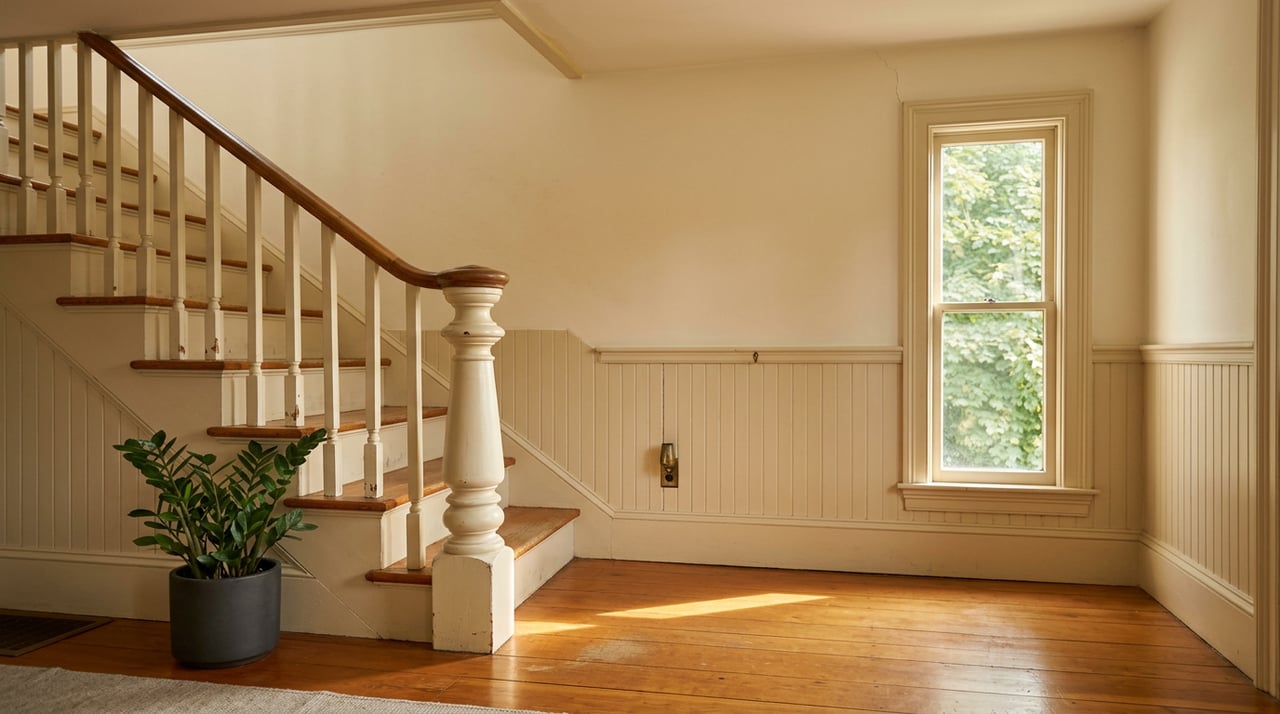
What Indiana's Disclosure Law Doesn't Ask: A Seller's Guide To Evansville's Historic Districts
Picture a seller at the kitchen table of a hundred-year-old foursquare on West Franklin Street, pen in hand, filling out the Indiana disclosure form. The question asks about the sewer line. She checks "no known issues," and she isn't lying. She has lived in the house for eleven years. Nothing has ever backed up. The clay pipe running from her foundation to the city main has never been scoped, so she has no way to know whether it's holding or slowly filling with roots from the maple two doors down.
That gap between what a seller knows and what is actually true under the yard is the whole story of selling an older home in Evansville. Indiana's disclosure law was written to protect honest sellers from liability for what they cannot see. In the newer subdivisions east of downtown, that protection rarely matters much, because the systems are young enough that problems tend to announce themselves before closing. In the city's historic districts, where houses were built before anyone alive today was born, the gap between "I disclosed everything I know" and "the house is sound" can run thousands of dollars wide.
Indiana Code 32-21-5 requires sellers of one to four unit residential property to complete the Seller's Residential Real Estate Sales Disclosure, State Form 46234, and deliver it before accepting a buyer's offer. The form itself states plainly that the information is correct to the seller's current actual knowledge as of the date it's signed. It also states, just as plainly, that it is not a warranty and is not a substitute for any inspection the buyer or seller might separately obtain.
Read those two lines together and the mechanism gets easy to see. The law does not ask what condition the house is in. It asks what the seller happens to know. A seller who has never had a sewer scope, never opened the electrical panel cover, and never crawled the foundation can fill out the form completely honestly and still hand a buyer a house full of problems neither party saw coming. The statute generally shields sellers from liability for honest mistakes made without negligence or actual knowledge of a defect. That protection is real. It just doesn't extend to what nobody bothered to look for.
Evansville's West Side carries some of the oldest continuously occupied housing stock in the region. The Independence Historic District, established in 1982, covers the inner West Side along West Franklin Street and Wabash Avenue, where homes range from Italianate to Victorian and the neighborhood still centers on the Laval Block, home to the West Side Nut Club's Fall Festival. The Riverside Preservation Area, nationally designated in 1962, contains 238 properties from the earliest chapter of the city's history. The Washington Avenue Historic District, created in 1980, runs from Parrett Street to Grand Avenue and has already lost a number of its grand Victorians to demolition, since a National Register listing offers no legal protection against it. A few blocks north, the Grove Street Residential Historic District holds a run of early twentieth century houses, including the Louis Spencer house at 116 Grove Street, built in 1910 and generally regarded as the finest Craftsman style home in the city.
None of that history shows up on a disclosure form. What it means in practice is that a much higher share of West Side listings were built before anyone had a name for a home inspection, let alone a habit of getting one every few years. Compare that to a district like Hebron Meadows on the far East Side, established in 2018 to recognize a cluster of post-war ranch homes from the 1950s housing boom. Those houses are old enough to need attention too, but their systems run two or three decades younger on average, and the codes that governed them were already catching up to modern safety standards. The age gap between West Side and East Side inventory is close to exactly the gap between what a seller can honestly claim to know and what a scope or a panel inspection would actually show.
A local inspector licensed under Indiana Home Inspector License #HI02100119 who works the Evansville market puts it directly: the city's older housing stock commonly presents aging electrical panels, including Federal Pacific Stab-Lok and Zinsco brands, along with cast iron drain stack corrosion and remnants of knob-and-tube wiring. None of those conditions typically cause a visible problem while a family is living normally in the house. They surface during an inspection, or they surface during a claim, and rarely at any point in between.
| Hidden system | What ages it | Cost to check now | Cost if it's missed |
|---|---|---|---|
| Sewer lateral (clay pipe common pre-1960s) | Root intrusion, joint cracking, decades without a scope | $180 to $220 for a sewer scope | Average $7,500 to repair undetected damage |
| Electrical panel | Original Stab-Lok or Zinsco hardware still in service | Included in a general inspection | Full panel replacement, plus possible insurance friction tied to the brand |
| Cast iron drain stack | Interior corrosion invisible from finished walls | Included in a general inspection | Stack replacement, often requiring wall or ceiling access |
A general home inspection in Evansville runs roughly $300 to $700 depending on the size of the house, and that cost typically falls on the buyer during a standard purchase. A seller who orders a sewer scope and a general inspection before listing spends a few hundred dollars finding out what the disclosure form can't ask about, and walks into negotiations already knowing the answer instead of learning it from the buyer's inspector.
There's a piece of this that doesn't depend on what the seller knows at all. Federal law requires anyone selling a home built before 1978 to disclose any known lead-based paint hazards, provide the EPA's lead information pamphlet, and give the buyer a ten day window to conduct a lead inspection before the contract is finalized. Given how much of the West Side, Riverside, and Washington Avenue inventory predates that cutoff by half a century or more, this isn't a rare exception. For a large share of historic district listings, it's the baseline.
The disclosure form asks what a seller knows. A pre-listing inspection is how a seller finds out. For a house in the Independence, Riverside, Washington Avenue, or Grove Street districts, that typically means:
None of this changes what the law requires. It changes what a seller actually knows before signing a form that asks them to certify it.
Does Indiana require a pre-listing inspection before I sell? No. The law requires the disclosure form, not an inspection. A pre-listing inspection is a choice, and in older housing stock it's often the difference between disclosing accurately and disclosing honestly but incompletely.
Am I liable if my sewer line fails after closing and I didn't know about it? Indiana generally shields sellers from liability for defects they didn't actually know about and weren't negligent in failing to discover. The protection applies to honest gaps in knowledge. It does not apply if you knew about a problem and left the box unchecked.
Does the lead paint rule apply even if I've never seen lead paint in my house? The disclosure obligation is triggered by the home's age, not by visible paint condition. Any home built before 1978 falls under the federal rule regardless of what the seller has or hasn't observed.
Is a sewer scope worth it if the house has never had a backup? A clay lateral can crack at a joint and still drain adequately for years before a full blockage forms. The scope exists because the failure mode is slow and mostly invisible until it isn't.
If you're weighing a sale in one of Evansville's historic districts, or trying to figure out what a specific West Side or Riverside address is actually carrying underground and behind the walls, Pinnacle Realty Group works this market block by block, including the age profile and inspection history that doesn't show up on a listing sheet. Reach out to broker/owner Jason Brown to start your search with our local experts and get a straight read on what a pre-listing inspection would likely turn up before a buyer's inspector finds it first.



We pride ourselves in providing personalized solutions that bring our clients closer to their dream properties and enhance their long-term wealth. Contact us today to find out how we can be of assistance to you!