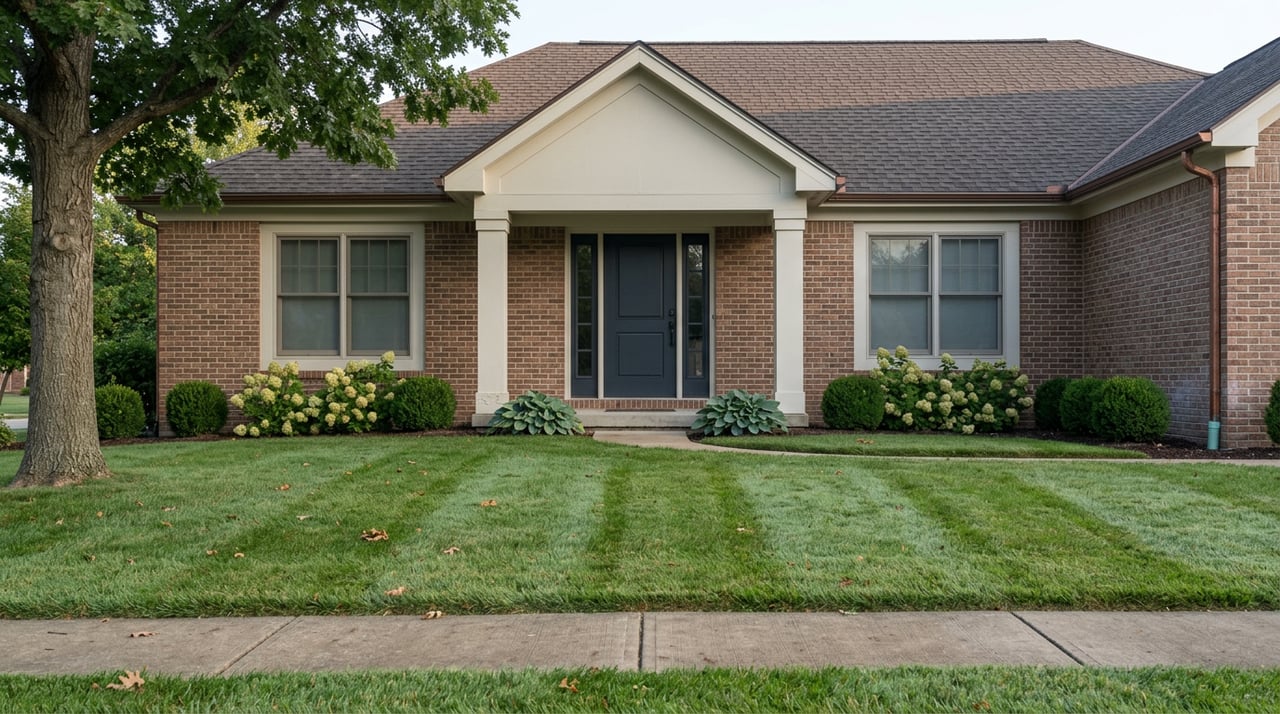
Mount Vernon and New Harmony Aren't the Same Market. The Median Price Pretends They Are.
Pull two housing reports for Posey County right now and you'll get two different stories. One tracker puts the average home value at $241,834, up 2.1 percent over the past year. Another, looking at the three months ending in May 2026, shows the median sale price down 23.4 percent year over year, with just 14 homes sold that month countywide. Same county. Same spring. Numbers moving in opposite directions.
Neither report is wrong. The problem is the question. "What's happening to prices in Posey County" assumes Posey County is one market. It isn't. Mount Vernon and New Harmony sit fifteen minutes apart and behave like two different economies, because they are. One is an industrial river town adding jobs and building a bypass. The other is a National Historic Landmark district with a population under a thousand and, on a given week, one or two houses for sale. Average them together and you get a number that describes neither place.
Fourteen sales is not a lot to draw a countywide conclusion from. When a sample that small includes a mix of a modest starter home in one town and a large riverfront property in another, the median can swing hard in either direction without any actual shift in what typical buyers are paying for typical homes. That's what's happening at the county level here. To get a number you can actually use, you have to split the county apart and look at the two markets doing the pulling.
Start with the town that has real transaction volume. Over the three months ending in May 2026, Mount Vernon's median sale price was $200,000, down 6.2 percent from the year before. That's a meaningful decline, not noise, because it's backed by actual sales activity: 25 homes changed hands in May 2026 alone, up from 23 the year before. Days on market fell from 55 to 23 over the same stretch. A market with that much volume and that much speed isn't drifting. It's responding to something.
That something is largely employment. Mount Vernon is home to the Ports of Indiana-Mt. Vernon, the seventh-largest inland port complex in the country, and it carries an industrial base most towns this size don't have:
Layered on top of that is the Western Bypass, a road project a decade in the making. The county broke ground in August 2024 and closed a stretch of Base Road in May 2025 for roughly a year to build it. When bids opened in March 2026, the lowest came in at just over $12.2 million, well above the original $7 million estimate. Posey County Commissioner Bill Collins has framed the project as more than traffic relief: rerouting semi-truck traffic off Main Street is also meant to open land on the town's northeast side, where a lack of roads has kept both industrial and residential development from happening at all. That's a direct acknowledgment from county leadership that Mount Vernon has a housing supply problem right now, tied to the same industrial growth pulling the median down through faster, cheaper starter-home turnover.
None of that means Mount Vernon is cooling off. It means the town has enough sales volume for a six percent shift to mean something, and enough industrial and infrastructure activity in motion to explain it.
Now look at New Harmony, and the picture flips completely. At different points in 2026, MLS-fed listing pages for the town have shown as few as one active listing and as many as three. In March, two listings put the median list price near $270,000. By June, a different snapshot with three active listings averaged above $300,000, and yet another June count of two listings priced closer to $330,000. By early August, with just one home on the market, the number dropped to $99,900.
That is not a market swinging by six figures in five months. It's the same tiny inventory being measured at different moments, the way a poll of two people can flip completely depending on who answers the phone.
New Harmony's inventory stays this thin for reasons baked into the town itself. It was founded between 1814 and 1815 as Harmonie, a communal settlement under Johann Georg Rapp, later sold to industrialist Robert Owen, who renamed it and launched his own experiment in cooperative living. That history is still visible on the ground: the town's historic district holds National Historic Landmark status, its population sits under a thousand, and its economy runs on preservation and tourism rather than housing turnover. Its draws, the Cathedral Labyrinth, the Working Men's Institute (Indiana's oldest continuously operating public library), and nearby Harmonie State Park, bring visitors, not a rotating population of new residents. People who buy in New Harmony tend to stay, and the historic district's preservation rules limit how much new construction can appear to replace what doesn't turn over.
For a buyer, that thin inventory creates a specific, practical problem: appraisal risk. When only one to three homes are on the market at a given time, an appraiser has almost nothing recent and comparable to lean on. A single unusually renovated sale, or a single distressed one, can become the de facto comp for the whole town, pulling an appraisal higher or lower than a buyer expects. That's not a hypothetical. It's the direct consequence of the same small-sample problem showing up in the median.
| Mount Vernon | New Harmony | |
|---|---|---|
| Monthly sales volume (May 2026) | 25 homes sold | 1 to 3 active listings at any time |
| Days on market trend | Down from 55 to 23 days year over year | Ranging from 9 to 82 days depending on which listings happen to be active |
| Primary demand driver | Industrial employment, port activity, new infrastructure | Historic preservation, tourism, low turnover |
| Reliability of the median | High enough sample size for the number to reflect real movement | Too thin to represent a trend; reflects whichever homes happen to be listed |
| What it means for a buyer | Expect competition and move on comps quickly | Expect a longer process and budget extra time for appraisal contingencies |
Why do different sites show different numbers for the same county? Because a countywide median only means something when it's built from a large, comparable set of sales. Posey County's is built from a mix of a high-volume industrial town and a nearly untraded historic one, so the number moves based on which town happens to have more activity in a given window rather than any single trend.
Is New Harmony's thin inventory likely to change soon? Nothing in the town's current pattern suggests it will. Historic district preservation limits new construction, the population has stayed under a thousand, and the local economy runs on tourism and arts rather than the kind of job growth that drives housing turnover elsewhere in the county.
Will the Western Bypass actually move Mount Vernon home values? It's too early to say with certainty, since the project is still under construction. What's clear is that county leadership is explicitly tying the bypass to future housing development on land that currently has no road access, which makes it a real variable worth watching rather than background noise.
Comparing Mount Vernon to New Harmony on price alone will point you in the wrong direction, because the number describing each town is measuring two different things. If you're weighing a move between them, or anywhere else in Posey County, Pinnacle Realty Group can pull the actual comps for the specific street and price range you're looking at, not just the countywide average. Start your search with our local experts and get a clearer read on what you're actually buying into.
We pride ourselves in providing personalized solutions that bring our clients closer to their dream properties and enhance their long-term wealth. Contact us today to find out how we can be of assistance to you!